Let me paint a picture that might sound familiar. You sit down at your desk at 9am. You have good intentions. You are going to get up every hour, stretch a little, maybe take a walk at lunch. Then the meetings start, the emails pile up and you look at the clock and it is 3pm. You have barely moved.
This is the reality for a huge portion of the Metro Detroit workforce right now. Remote work has made it worse. When you work from home the commute that used to force you to walk to a parking structure or train platform is gone. The quick coffee run to the office kitchen is gone. The physical interruptions to sitting are gone. What is left is hour after hour of static compression on your joints, muscles and connective tissue.
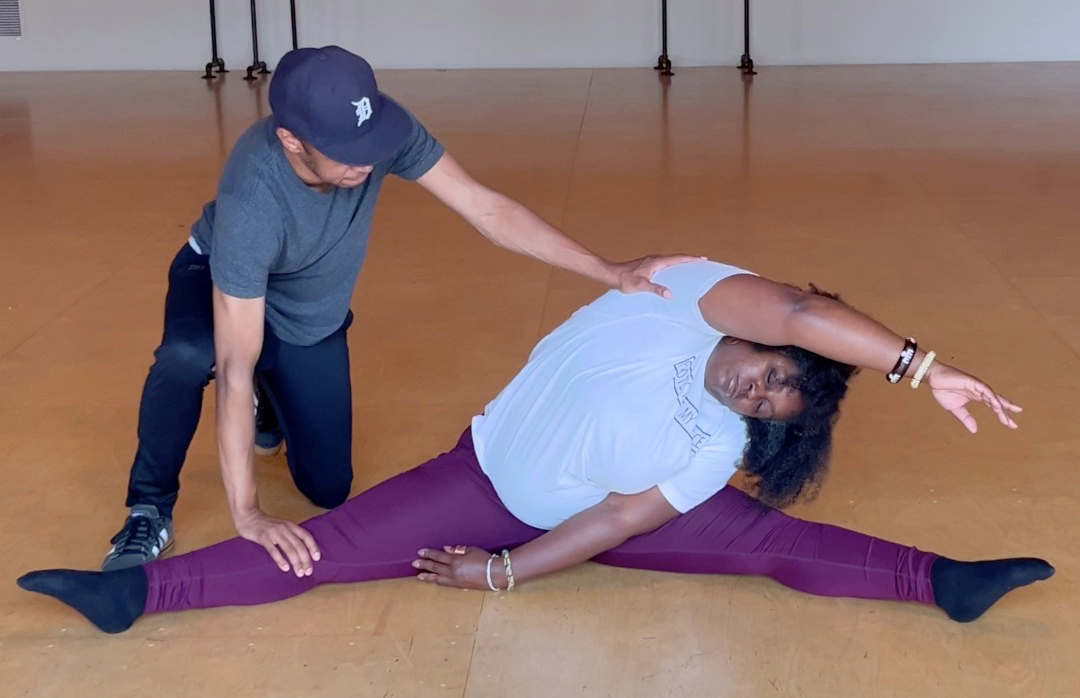
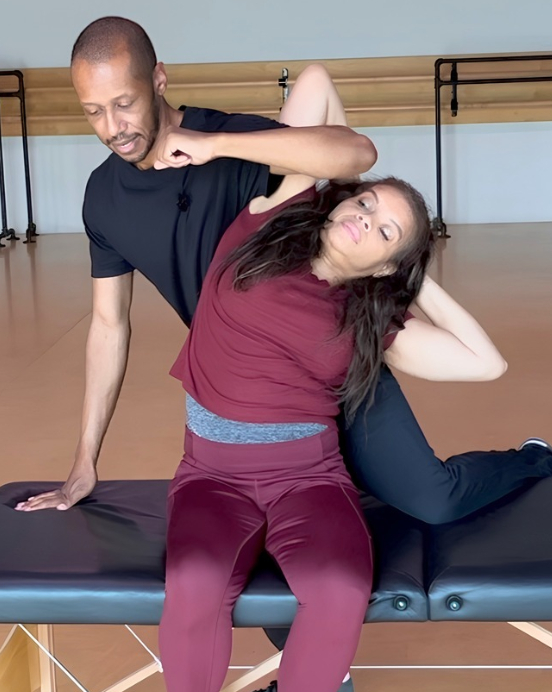
I work with desk workers and remote professionals across Southfield, Royal Oak, Ferndale and the surrounding communities every week. The pattern I see in their bodies is almost identical from client to client and the good news is that it responds very well to targeted assisted stretch therapy.
"Your body was not designed to hold one position for eight hours. It will tell you so — usually through your lower back, your hips or the base of your skull."
What Sitting Actually Does to Your Body
When you sit for extended periods several things happen simultaneously in the body. Your hip flexors — the muscles that connect your lower spine to your thighs — shorten and tighten because they are held in a contracted position. Your hamstrings, which run along the back of your thighs, adaptively tighten in response. Your glutes, which are supposed to be primary movers and stabilizers, become inhibited. They essentially stop firing correctly because they are not being used.
At the same time your thoracic spine — the middle section of your back — rounds forward as your chest tightens and your shoulders draw in toward the screen. Your neck compensates by jutting forward, which increases the effective weight load on your cervical spine dramatically. Research suggests that for every inch of forward head posture the effective weight of the head on the neck increases by roughly 10 pounds.
The result of all this over months and years is a predictable cascade of symptoms: chronic lower back pain, tight hip flexors that contribute to anterior pelvic tilt, stiff hamstrings, reduced thoracic mobility and persistent neck and shoulder tension. If any of that sounds familiar you are not alone and you are not broken. Your body has simply adapted to what you have been asking it to do.
Why Self-Stretching Is Not Enough
Here is something I tell clients who have tried foam rollers, YouTube stretch routines and yoga classes before coming to see me. Those tools are not bad. They just have a fundamental limitation. When you stretch yourself you are using the same neuromuscular system that is holding the tension to try to release that tension. The muscle cannot fully let go while it is also doing the work of the stretch.
Assisted stretching bypasses this problem entirely. When your therapist moves your limb through a stretch your neuromuscular system does not have to do anything. It can fully release. The proprioceptive neuromuscular facilitation (PNF) techniques we use at Detroit Stretch take this even further by using brief gentle contractions followed by guided lengthening to tap into the body's own inhibitory reflexes. The result is a depth of release that self-stretching cannot produce.
For desk workers this difference is particularly meaningful because the holding patterns built up over years of sitting are often deeply embedded. They require consistent professional attention to fully unwind.
The Most Common Areas I Address in Desk Worker Sessions
Primary Areas of Focus
- Hip flexors (psoas and iliacus) — chronically shortened from prolonged sitting, contributing directly to lower back pain and anterior pelvic tilt
- Hamstrings — tightened in response to hip flexor shortening, limiting posterior chain function and increasing injury risk
- Thoracic spine — stiffened by forward rounding at the desk, restricting rotation and contributing to neck pain
- Pectoral muscles and anterior shoulder — shortened by internal rotation at the keyboard, pulling the shoulders forward
- Suboccipital muscles at the base of the skull — chronically compressed by forward head posture, often the source of tension headaches
- Piriformis and glute complex — inhibited by prolonged sitting, contributing to hip dysfunction and sciatic-type symptoms
How Mobile Stretch Therapy Fits Into a Work Day
One of the most consistent things I hear from desk worker clients is that the mobile format is what made consistent care possible for them. A lunch hour session at home means you do not lose half your afternoon to commuting. You finish your session feeling restored and you are already home. You sit back down at your desk with more focus, better posture and less pain than you started the day with.
Several of my Southfield and Royal Oak clients have made weekly or biweekly mobile sessions part of their standard work routine the same way they might block time for exercise or a standing meeting. When stretch therapy becomes consistent the cumulative effect is significant. Clients report sustained improvements in range of motion, reductions in chronic pain and noticeably better energy through the afternoon.
What to Expect in Your First Session
Your first session begins with an assessment. I look at your posture, your gait and your range of motion across the major joints. For desk workers the findings are usually consistent — tight hip flexors, inhibited glutes, reduced thoracic rotation and forward head posture. But the degree and the specifics vary from person to person and the session is built around what your body actually needs.
From the assessment we move into the full body assisted stretch. You stay fully clothed. I guide your body through a sequence of targeted holds and transitions, checking in throughout to calibrate the depth of the work to your comfort level. Most clients notice a significant difference in how their lower back and hips feel before we even finish the session. By the time we wrap up and I pack up to leave you should feel noticeably looser, lighter and more upright than when we started.
Your Desk Is Not Going Anywhere.
Neither Is the Tightness — Unless You Address It.
Book your New Client Consultation and let us assess exactly what your body needs. We come to you anywhere in Southfield, Royal Oak, Ferndale and Metro Detroit.
Book Your First Session
60 minutes · Full assessment included · We come to you